Why Agent Strategy Becomes an Architecture Problem at Scale
Most enterprises are repeating the microservices mistake with agents: letting teams adopt locally before the enterprise defines the control plane. The result is predictable. Multiple agent frameworks. Inconsistent identity. Tool access nobody can explain. Costs that show up only after the workflow crosses three systems. By the time architecture gets involved, the problem is no longer experimentation. It is cleanup.
This is already happening. Gartner predicts 40% of enterprise applications will feature AI agents by the end of 2026, up from less than 5% in 2025. Salesforce's 2026 Connectivity Report found that organizations average 12 agents each, with half of them operating in isolated silos. The adoption curve is steep. The governance curve is flat.
The question is not whether your organization will deploy agents. It is whether anyone is defining the control plane before the agents arrive.
Agent Systems Are Not Model Deployments
The instinct in most organizations is to treat agent adoption as a model deployment problem. Build the agent, evaluate the outputs, deploy to production, monitor for drift. That works for predictive models. It does not work for agents.
An agent is a distributed system with autonomy, tools, permissions, state, and real-world effects. It reasons, selects tools, calls external services, delegates to other agents, and takes actions with consequences. The failure mode is not "the prediction is wrong." It is "the agent performed an action it was not authorized to perform, through a delegation chain nobody reviewed, in a system that had no audit trail for the decision."
Reports of enterprise agent security incidents are increasing. Industry surveys in early 2026 suggest the vast majority of organizations have experienced confirmed or suspected agent-related security events, and most agents reach production without full security or IT approval. The pattern is consistent: teams deploy agents with the same controls they use for model endpoints, and discover too late that agents create a fundamentally different risk surface.
This is not a model-quality problem. It is a system-design problem. And system design is what enterprise architecture exists to govern.
Five Cross-Cutting Concerns That Require Architecture-Level Ownership
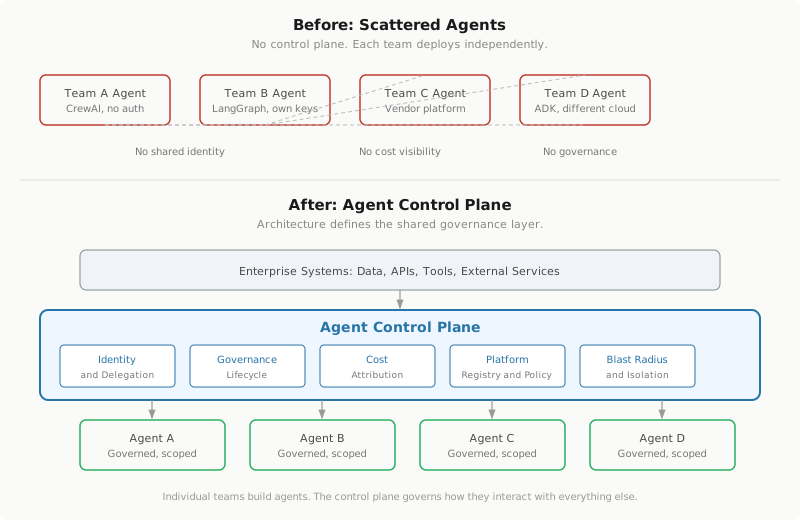
1. Trust, Identity, and Delegation
When Agent A delegates to Agent B, which calls a tool on behalf of a user, who authorized what? MCP now defines an OAuth-based authorization model for secure client-server interaction. A2A and adjacent ecosystems are moving toward signed or verifiable agent metadata. But neither solves multi-hop delegation chains where scope, budget, and authority need to narrow at each hop.
There are multiple active proposals across IETF and adjacent standards efforts, from JWT-based approaches to hardware-anchored registries to selective-disclosure tokens. No standard has been adopted. The architecture function must set the organization's identity and delegation strategy for agents before teams independently adopt incompatible approaches.
This is the concern where the gap is widest. Not just authentication, but delegation. Not just access control, but scope reduction across hops. Not just observability, but provenance: the ability to reconstruct, after the fact, exactly which agent authorized which action through which chain.
2. Governance Lifecycle
Microsoft released their open-source Agent Governance Toolkit in April 2026. AWS launched Agent Registry in preview the same month. Salesforce, Google, and OpenAI each ship their own governance layers. These tools handle runtime policy enforcement: what agents can and cannot do at execution time.
What none of them address is the lifecycle. Who reviews agent designs before deployment? Who approves scope changes when an agent gets new tool access? Who retires agents when their business function changes? Who reconstructs the delegation chain after an incident?
In regulated industries, this is not optional. It is the same discipline that architecture review boards apply to service deployments, data flows, and integration patterns. Agents are not exempt because they are new.
3. Cost Attribution
Agents consume significantly more compute per interaction than chatbot-style systems: multiple model invocations, tool calls, API requests, and database queries per workflow. FinOps tooling has matured rapidly, but it still tracks at the token and API-call level.
The missing layer is agent-level cost attribution to business outcomes. When a procurement agent orchestrates fifteen tool calls to produce a purchase recommendation, which business unit pays? How do you compare that cost to the manual process it replaced? This is a chargeback model problem, and the architecture function has been solving chargeback model problems for shared services for decades.
4. Platform Capability
Every major cloud vendor is now building agent platform services: AWS Agent Registry, Google Agent Engine, Microsoft Foundry Agent Service, Salesforce Agentforce. Each bundles tool registries, policy engines, identity services, and observability differently.
If your organization uses agents on more than one platform, someone needs to define the vendor-neutral shared services layer. Where do agents register? Where do policies live? How does identity work across platforms? What is the observability standard?
This is platform architecture. It is the same discipline that produced shared API gateways, service meshes, and identity providers. Without it, you get the same fragmentation those patterns were designed to prevent.
5. Blast Radius and Failure Isolation
Architecture defines failure boundaries. When an agent goes wrong at 3am, what is the blast radius? Can it affect systems it was not designed to interact with? Are there circuit breakers? Is there a human-in-the-loop escalation path that actually works under load?
These are the same questions architecture asks about any distributed system. Agents add a complication: non-deterministic behavior. The same agent, given the same input, may take a different path. Failure isolation patterns need to account for this, which means tighter scope constraints, explicit tool whitelists, budget ceilings, and automatic revocation when a workflow exceeds its expected bounds.
Three Artifacts Architecture Must Create
If you run an architecture function, the deliverables are concrete.
An agent reference architecture. Bain published a three-layer model: orchestration, agent, data. The California Management Review proposed a four-layer Agentic Operating Model covering cognitive specialization, coordination architecture, real-time control, and organizational governance. Your organization needs its own reference architecture, informed by these frameworks but specific to your platform stack, your regulatory environment, and your operating model.
An agent review standard. When a team proposes an agent system, the architecture review should cover: identity and delegation model, governance lifecycle, cost attribution, failure isolation, human-in-the-loop design, data access scope, and revocation strategy. These are not nice-to-haves. They are the equivalent of security review, data classification, and disaster recovery planning for a new class of distributed system.
A shared agent control plane. This is the most important artifact. The control plane unifies identity, policy, registry, observability, cost controls, and blast-radius enforcement in one layer. Individual teams build agents. The control plane governs how those agents interact with everything else: tools, data, other agents, and the enterprise itself. Without a control plane, you have agents. With one, you have a governed agent platform.
The Window Is Closing
Gartner predicts that by 2030, half of all AI agent deployment failures will stem from insufficient governance and broken interoperability. The organizations that wait for the architecture function to get involved will inherit dozens of ungoverned agents rather than designing a governed platform.
The ML teams are already building. The vendors are already shipping. The standards are still being written. The architecture function that engages now shapes the outcome. The one that waits inherits the cleanup.
The real architecture problem is not how to build one good agent. It is how to let hundreds of agents act inside the enterprise without losing identity, policy, cost control, and accountability. That is what a control plane is for. And it is enterprise architecture's job to build it.
Related reading:
- The AI Center of Excellence Is Dead. Long Live the AI Operating Model.
- Your ML Risk Framework Wasn't Built for GenAI. Here's What's Missing.
- The Agent Identity Gap: Why MCP and A2A Need Verifiable Delegation
For a deeper treatment of how to build, evaluate, harden, and govern production agent systems, see Agentic AI for Serious Engineers (Amazon, 2026). For a practical AI governance framework covering risk classification, lifecycle controls, and multi-jurisdiction compliance, see ai-governance-framework on GitHub.