Enterprise data platforms and operational platforms solve different problems under different constraints. Confusing them leads to wrong SLAs, wrong funding models, and platforms that fail at both jobs. This page compares the two across 12 dimensions so architects and leaders can draw a clear line. Neither platform is better; they coexist, and the question is which workload belongs where. If you are building one platform to rule them all, you are building zero platforms that work.
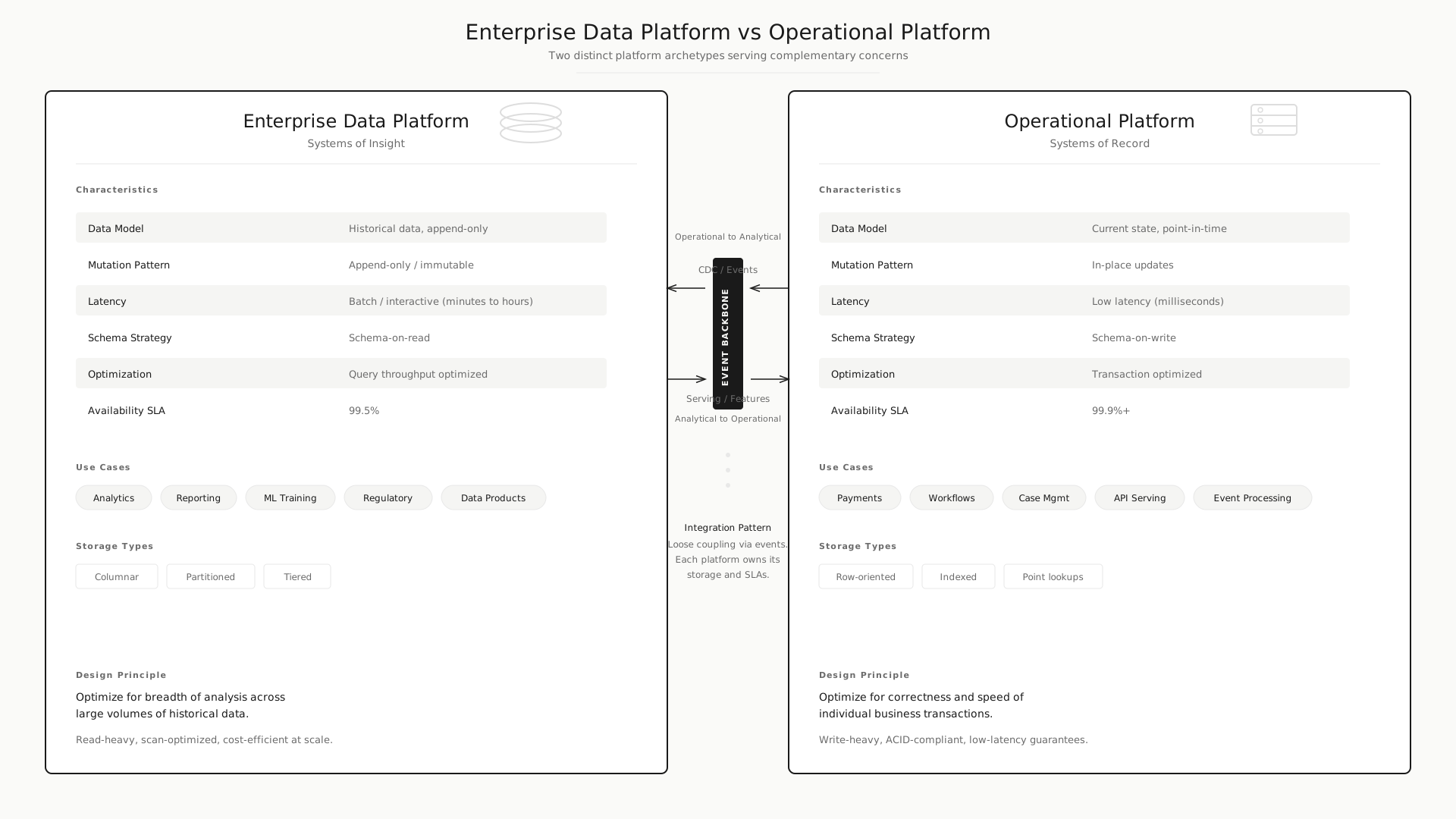
The Comparison
| Dimension | Enterprise Data Platform | Operational Platform |
|---|---|---|
| Purpose | Integrate, historize, analyze, govern data across domains | Execute business processes, manage live state, serve transactions |
| Latency expectation | Minutes to hours (batch), seconds for interactive queries | Milliseconds to low seconds |
| Workload type | Analytical queries, aggregations, ML training, reporting | OLTP transactions, event processing, workflow execution |
| Source of truth | Integrated historical truth across domains | Current operational state for a specific domain |
| Data mutation | Append-mostly, immutable history, SCD patterns | In-place updates, deletes, ACID transactions |
| SLA/SLO | Query performance, data freshness, completeness | Uptime, response time, transaction throughput |
| Consumers | Analysts, data scientists, BI tools, regulatory teams | Applications, APIs, workflow engines, end users |
| Storage pattern | Columnar, partitioned, tiered (hot/warm/cold) | Row-oriented, indexed, optimized for point lookups |
| Governance style | Centralized cataloging, lineage, access policies, data quality | Application-level validation, API contracts |
| Failure tolerance | Retry, reprocess, backfill; delay acceptable, data loss not | Must not lose a transaction, failover required |
| Cost model | Storage-heavy, compute-on-demand, query-based billing | Compute-heavy, always-on, connection-based |
| Scaling pattern | Scale storage and compute independently, elastic | Scale for concurrent connections and transaction throughput |
Use Case Examples
Belongs on EDP
- Customer 360 analytics across all product lines
- Regulatory reporting (BCBS 239, DORA)
- Executive management information dashboards
- ML model training on historical transaction data
- Data quality monitoring across domains
- Self-service analytics for business users
- Historical trend analysis for pricing or risk
Belongs on Operational Platform
- Payment processing and settlement
- Case management workflow
- Real-time fraud scoring during transaction
- Inventory management and order fulfillment
- API serving for customer-facing applications
- Event-driven process orchestration
- Session state management
Shared / Integration Layer
- Customer master data (MDM as source, EDP as historical consumer)
- Feature serving (EDP computes features, serving layer delivers at low latency)
- Reporting APIs (EDP produces data, API layer serves it)
- Event backbone (connects operational events to EDP ingestion)
The Data Flow Between Them
graph LR
    subgraph Operational
        A[Source Systems] --> B[Event/Message Backbone]
        B --> C[Operational Services]
        C --> D[Operational Data Store]
    end

    subgraph EDP
        B --> E[Ingestion Layer]
        E --> F[Raw / Bronze]
        F --> G[Curated / Silver]
        G --> H[Consumption / Gold]
        H --> I[Data Products]
    end

    subgraph Serving
        I --> J[Feature Store / APIs]
        J --> C
    end
The Convergence Argument
The obvious objection to this page, as of 2026, is that the vendors are collapsing the boundary it draws. Databricks ships Lakebase, a managed Postgres inside the lakehouse, and markets transactional-plus-analytical processing on the same governed data. Snowflake ships its own managed Postgres. Both pitch one platform for both sides of this comparison table. If the infrastructure is converging, is the distinction obsolete?
No, because the boundary was never about boxes. Read the table above again: latency expectations, mutation models, failure tolerance, SLA structures, cost models, scaling patterns. Those are properties of workloads and of the teams accountable for them, not of vendor platforms. A converged platform runs both workload types under one contract and one catalog, which is genuinely useful: shared governance, less data movement, one vendor conversation. What it does not do is merge the disciplines. The payment service still must not lose a transaction during the analytical platform’s maintenance window, which means it still needs its own failure domain, its own SLOs, its own on-call, and its own budget line, whatever logo is on the infrastructure.
The practical test survives convergence intact. For any workload, ask which failure domain it lives in and which SLO regime it answers to. If the answer is “operational,” it needs operational discipline, and running it adjacent to your analytics on a converged platform is a deployment choice, not an exemption. Buying convergence is a procurement decision; operating convergence is an organizational one, and the second does not follow from the first.
The full treatment of this argument, including the honest exceptions (the cases where direct analytical-platform access is legitimate, and the test that decides), is in Convergence Does Not Eliminate Responsibility Boundaries.
Common Mistakes
These are explored in depth in What Breaks When EDP Becomes Everything:
- Treating gold-layer tables as operational systems of record
- Running workflow orchestration on the analytical platform
- Expecting analytical SLAs for operational workloads
- Forcing all data needs into one platform because “strategic”