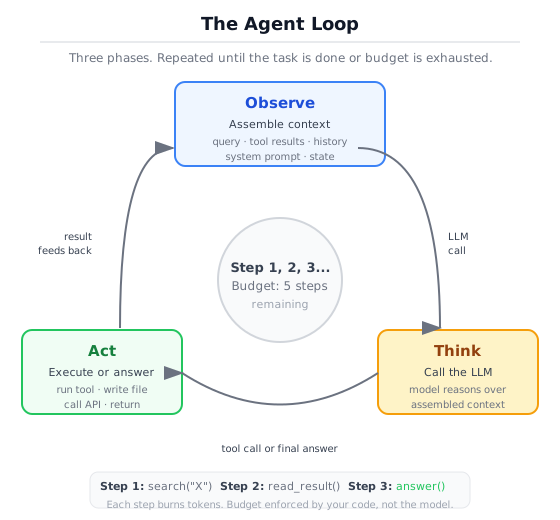
An expanded agent loop with configurable budgets, step-level token and cost tracking, JSON trace export, and graceful error recovery.
What’s inside
src/agent.py—ResearchAgent: the full instrumented loop. Extends the minimal agent fromsrc/ch00/raw_agent.pywith per-stepStepTraceobjects, accumulatedAgentTraceexport, and error recovery that captures exceptions as trace entries rather than terminating the run.src/tools.py— Four research tools with Pydantic validation:calculator,search,read_url(simulated URL fetch), andsummarize(LLM-powered summarisation via an injectableModelClient).src/run.py— CLI runner that takes a query, runs the agent, and prints the annotated trace. Optional--export PATHwrites the trace to JSON.evals/test_queries.yaml— Five benchmark queries with expected answers.evals/run_eval.py— Loads the YAML, runs the agent against each query using scripted mock responses, scores withscore_answer(), and prints a results table.
How to run
make install

# Single query
python project/research-agent/src/run.py "What is 15 * 7?"

# Single query with trace export
python project/research-agent/src/run.py --export trace.json "What is 100 / 4 + 10?"

# Full eval suite
python project/research-agent/evals/run_eval.py
What you’ll see
The CLI runner prints an annotated trace for each run:
Trace for: 'What is 15 * 7?'
Model: claude-haiku-4-5-20251001  max_steps: 8
------------------------------------------------------------
[1] tool_call  calculator({'operation': 'multiply', 'a': 15, 'b': 7})
      -> 105.0
      tokens=55  cost=$0.000044  42.3ms
[2] response  '15 * 7 = 105'
      tokens=85  cost=$0.000068  31.1ms
------------------------------------------------------------
Summary: 2 steps  140 tokens  $0.000112  73.4ms  [COMPLETED]
Answer:  15 * 7 = 105
The eval runner prints a scored results table followed by a summary:
Running eval harness against research_agent (MockClient)...

============================================================
Implementation: research_agent
============================================================
Query                                    Expected      Got                       Score
---------------------------------------- ------------ ------------------------- -----
What is 15 * 7?                          105          15 * 7 = 105                0.8
...

Pass rate: 5/5 (100%)
The trace format
The AgentTrace dataclass serialises cleanly to JSON for offline analysis:
{
  "query": "What is 100 / 4 + 10?",
  "model": "claude-haiku-4-5-20251001",
  "total_steps": 3,
  "total_cost_usd": 0.000276,
  "budget_exhausted": false,
  "answer": "100 / 4 + 10 = 35",
  "steps": [
    {"step": 1, "type": "tool_call", "tool": "calculator", "...": "..."},
    {"step": 2, "type": "tool_call", "tool": "calculator", "...": "..."},
    {"step": 3, "type": "response", "content": "100 / 4 + 10 = 35", "...": "..."}
  ]
}
Connection to the book
Section 0c introduces the raw agent loop — the simplest possible implementation where a model iterates between tool calls and text responses. This project adds the instrumentation layer that makes production agents debuggable. The three additions — per-step cost visibility, exportable traces, and captured error recovery — each appear again in later chapters:
- Per-step cost tracking is the foundation for the cost profiler in Chapter 6.
- Trace export feeds the failure analysis workflow in Chapter 6’s hardening section.
- Error recovery as a design pattern (capture, log, continue) is formalised in Chapter 8’s reliability section.